πŸš€ LAUNCHING SOON β€” BTM-K1

Building automation controllers with eyes, ears, and instinct.

BTM Controls is an innovative designer of specialty controls components. Our first complete BAS controller β€” the BTM-K1 β€” goes head-to-head with the Tridium JACE 9000 and Distech ECLYPSE APEX at a fraction of the price.

See the Comparison Get Launch Updates
β˜… Beat'em with BTM β˜…
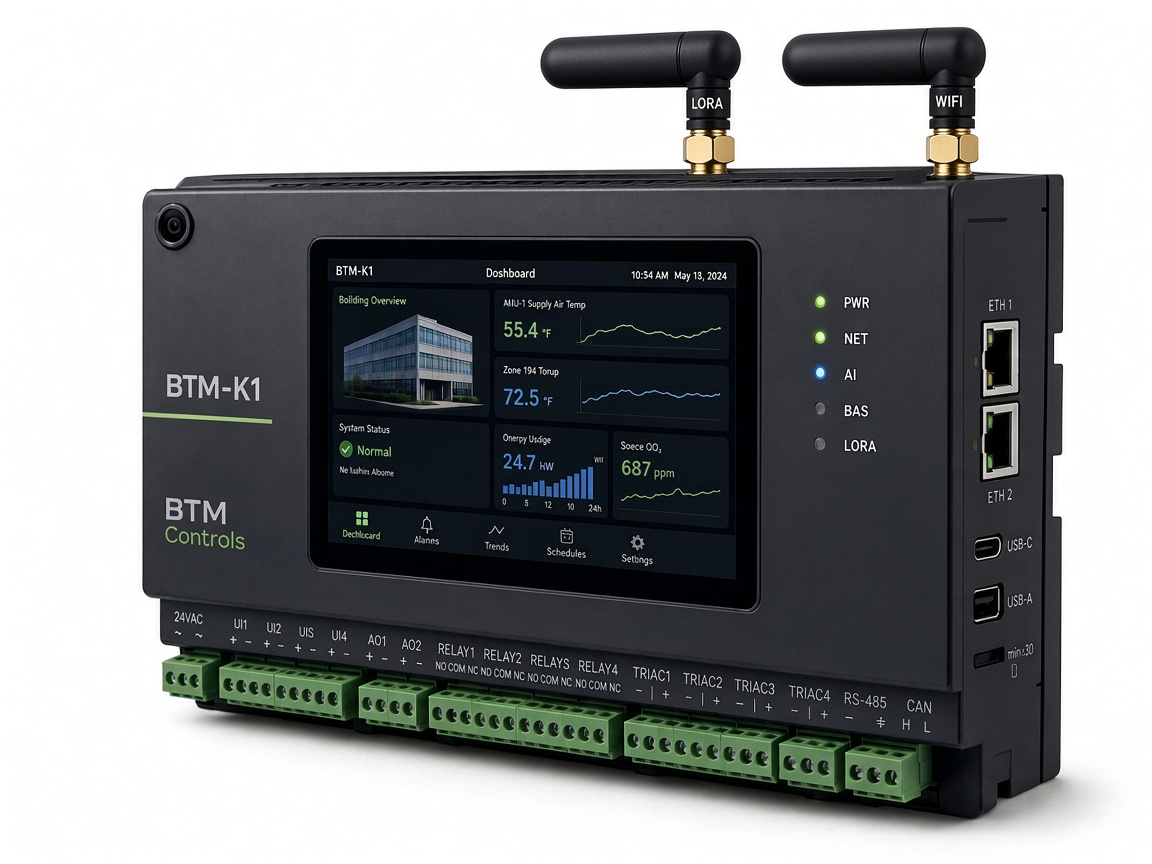
BTM-K1 AI Building Automation Controller with dedicated Wi-Fi and LoRaWAN antennas

Meet the BTM-K1

A supervisory controller, unitary controller, vision-AI edge device, and wireless gateway β€” in one DIN-rail box. No per-point licensing. No vendor lock-in. Linux platform.

🧠

Quad-Core 64-bit Compute

Industrial TI Sitara-class quad Cortex-A53 @ 1.4GHz with a dedicated real-time M4F core and 1GB DDR4 β€” JACE 9000-class horsepower on a Debian Linux platform.

πŸ‘οΈ

On-Board Vision AI

Dedicated NPU co-processor with camera input runs person detection β€” waking the display when a tech steps up β€” plus points-list and programming-document scanning: show the K1 your submittal schedule and it reads the points for setup. All at the edge, fully offline, no cloud. No competitor ships this.

πŸ–₯️

Touchscreen HMI

Integrated color touchscreen shows live points, alarms, and trends right at the panel β€” plus a full HTML5 web UI and phone-based commissioning hotspot.

πŸ”Œ

Real On-Board I/O

4 universal inputs (0-10V / 4-20mA / 10K thermistor / dry contact / pulse), 2 analog outputs, 4 relays, 4 triacs β€” 14 points, miswire-protected. Enough to run a packaged RTU standalone. The base JACE ships with zero on-board I/O.

🌐

Every Protocol That Matters

BACnet/IP & MS/TP, Modbus RTU/TCP, CAN-FD, MQTT, 1-Wire, Zigbee/Thread/Matter, BLE 5.3, WiFi 6, and private US915 LoRaWAN β€” plus dual Gigabit Ethernet with daisy-chaining.

πŸ“‘

Private LoRaWAN Site Gateway

The K1 is the site’s private US915 LoRaWAN gateway, network supervisor, and protocol translator. Its multichannel SX1302-class concentrator connects long-range BTM field controllers without putting every device on the customer’s WiFi or IP network. ChirpStack, device enrollment, RF health, alarms, and BACnet/MQTT translation stay local.

πŸ›‘οΈ

Panel-Grade Engineering

24VAC/DC panel power, isolated RS-485 field bus, surge & miswire protection on every terminal, power-fail safe shutdown, hardware secure element.

⚑

BTM PowerGuardβ„’

Integrated maintenance-free supercapacitor backup with intelligent load shedding, graceful shutdown, and outage reporting β€” the K1 tells you the power failed instead of just going dark. Hardware soft-shutdown is built into the circuit itself, so power-down is always clean β€” even if software hangs. No competitor controller ships battery-free ride-through as standard.

πŸ“ˆ

Predictive, Not Reactive

Neural-network Model Predictive Control learns your building's thermal inertia and optimizes against real-time grid pricing β€” pre-cooling when power is cheap, coasting through the peak. Reactive PID controllers can't do this. See how it pays for itself β†’

πŸŽ™οΈ

Ask the Controller

Push-to-talk voice assistant at the panel. A tech presses the button, asks "why did the fan lock out?" β€” and the K1 answers on its own screen, from its own data, fully offline. An embedded language model, no cloud, no account, no subscription.

🚨

Explain This Alarm

One alarm cascade, forty alarms β€” one button. On-board AI reads the K1's own trend history and tells you which alarm is the root cause and which are just consequences. Grounded in your data, not internet guesses.

πŸ“³

AI Machine Health

Predictive machine-health algorithms in the core runtime. The K1 baselines what it already measures β€” cycle counts, run hours, temperatures, filter DP β€” plus inexpensive vibration sensors on its inputs, then flags bearing wear, imbalance, and short-cycling as alarm points before failure. The $5,000 vibration-monitoring system is the included standard integration with K1 with everything included except readily available vibration sensors.

AI that advises. Deterministic hardware that acts.

One rule is wired into the K1's architecture: the AI never touches an output. Intelligence reads, explains, and proposes β€” but every physical write goes through the standard BACnet priority array, executed by a dedicated real-time core that doesn't take suggestions. You get the insight of AI with the determinism your AHJ, your insurer, and your 2 AM callback all demand.

Network security assurance

K1 security is layered from the network to the output

K1's update architecture uses an authenticated HTTPS channel, a per-controller security token, and SHA-256 package-integrity verification. Hardware architecture includes secure-element key storage. Core control remains local and can operate without cloud access, while AI is read/advisory only: every physical write stays behind the deterministic control path and standard BACnet priority handling. For deployment, K1 is intended for a dedicated BAS/OT VLAN with firewall rules limited to approved management, update, and integration hosts.

One Box. One RTU. Zero Expansion Modules.

With 4 universal inputs, 2 analog outputs, 4 relays, and 4 triacs on-board, the BTM-K1 directly handles a surprising percentage of small mechanical systems β€” no expansion module, no second enclosure, no extra bus. A complete packaged rooftop unit fits inside the K1's own terminals:

Fan status, supply-air, mixed-air, and filter DP on the inputs. Fan enable, two cooling stages, and heat on the relays. OA damper, heating valve, cooling valve, and an auxiliary actuator on the triacs β€” a very capable standalone controller before you ever add a BTM-IO module.

Packaged RTU β€” point-for-point on one K1
UI 1Fan status
UI 2Supply-air temp
UI 3Mixed-air temp
UI 4Filter DP
Relay 1Fan enable
Relay 2Cooling stage 1
Relay 3Cooling stage 2
Relay 4Heat enable
Triac 1Outside-air damper
Triac 2Heating valve
Triac 3Cooling valve
Triac 4Auxiliary actuator

Talk to the Engine. Skip the Gateway.

The K1's on-board CAN-FD / J1939 port connects directly to equipment ECUs β€” emergency generators, engines, chillers, VFDs β€” over a single pair of wires. No protocol gateway, no extra box, no integrator markup.

Wire the K1 to a generator's engine controller and it reads RPM, oil pressure, coolant temp, fuel level, battery voltage, engine hours, load, and active fault codes β€” then exposes every point upstream as BACnet/IP, BACnet MS/TP, Modbus TCP, MQTT, and the K1 web interface. The K1 becomes the protocol translator. A dedicated J1939-to-BACnet gateway alone runs $800–$1,500 β€” the K1 has it built in.

Emergency generator β€” direct over CAN/J1939
RPMGenerator engine speed
PSIOil pressure
Β°FCoolant temperature
VDCBattery voltage
%Fuel level
HRSEngine hours
kWGenerator load
DTCActive faults & diagnostic codes
β†’ served upstream as BACnet/IP Β· MS/TP Β· Modbus TCP Β· MQTT Β· Web UI

The BTM-IO Family

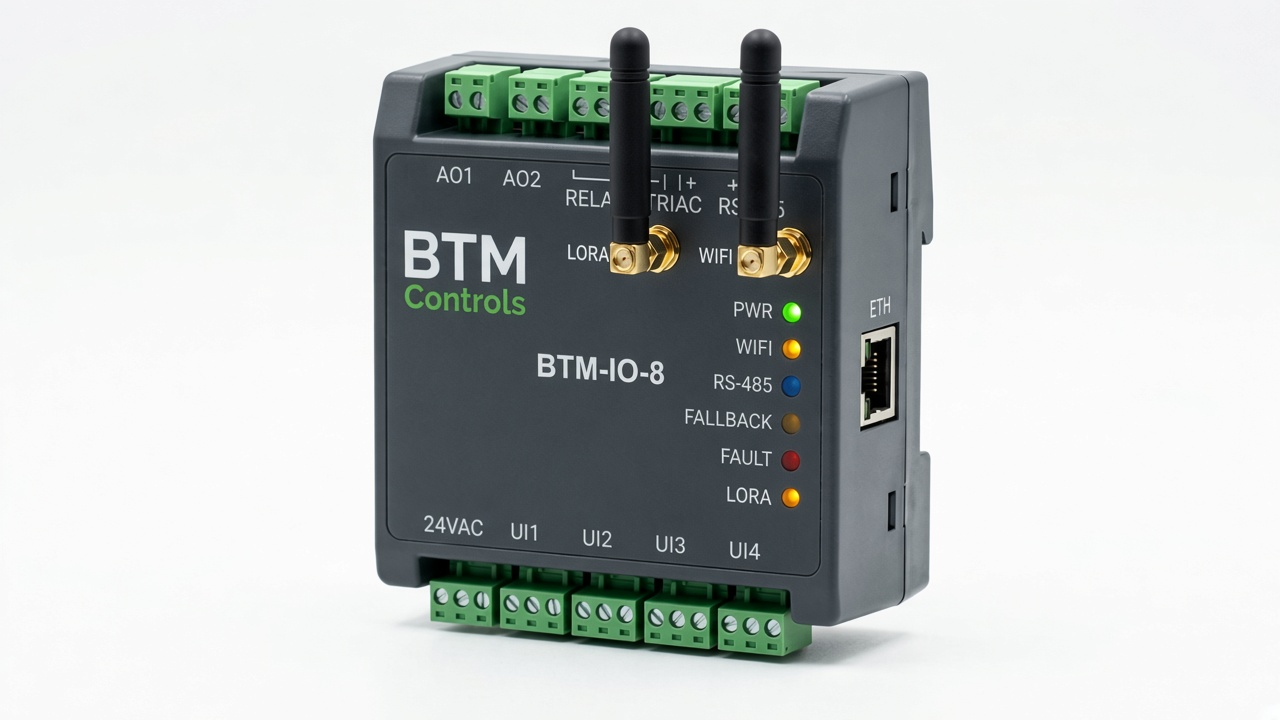
Remote I/O that cuts the wire. BTM-IO modules connect directly to the BTM-K1 over private US915 LoRaWAN, WiFi 6, Ethernet, or isolated RS-485. The K1 supervises the private long-range network while each field controller retains its own deterministic control, safeties, last commands, and fallback program.

BTM-IO-8 compact remote I/O with dedicated Wi-Fi and LoRaWAN antennas

BTM-IO-8

Compact 8-point · half-width footprint
  • 4Γ— universal inputs
  • 2Γ— analog outputs (0-10V / PWM)
  • 1Γ— relay (Form C, 5A) + 1Γ— triac
  • Private US915 LoRaWAN + WiFi 6 + Ethernet + isolated RS-485
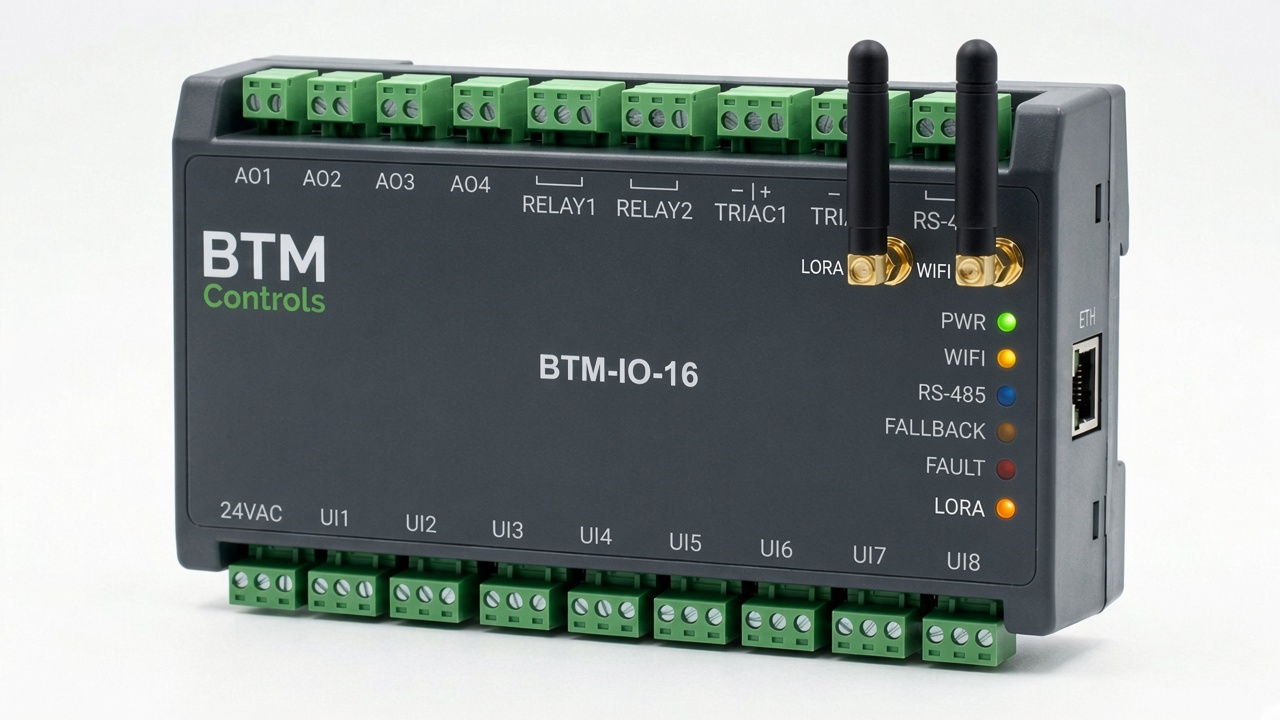
BTM-IO-16 remote I/O with dedicated Wi-Fi and LoRaWAN antennas

BTM-IO-16

The workhorse · full unitary point mix
  • 8Γ— universal inputs
  • 4Γ— analog outputs (0-10V / PWM)
  • 2Γ— relays (Form C, 5A) + 2Γ— triacs
  • Private US915 LoRaWAN + WiFi 6 + Ethernet + isolated RS-485
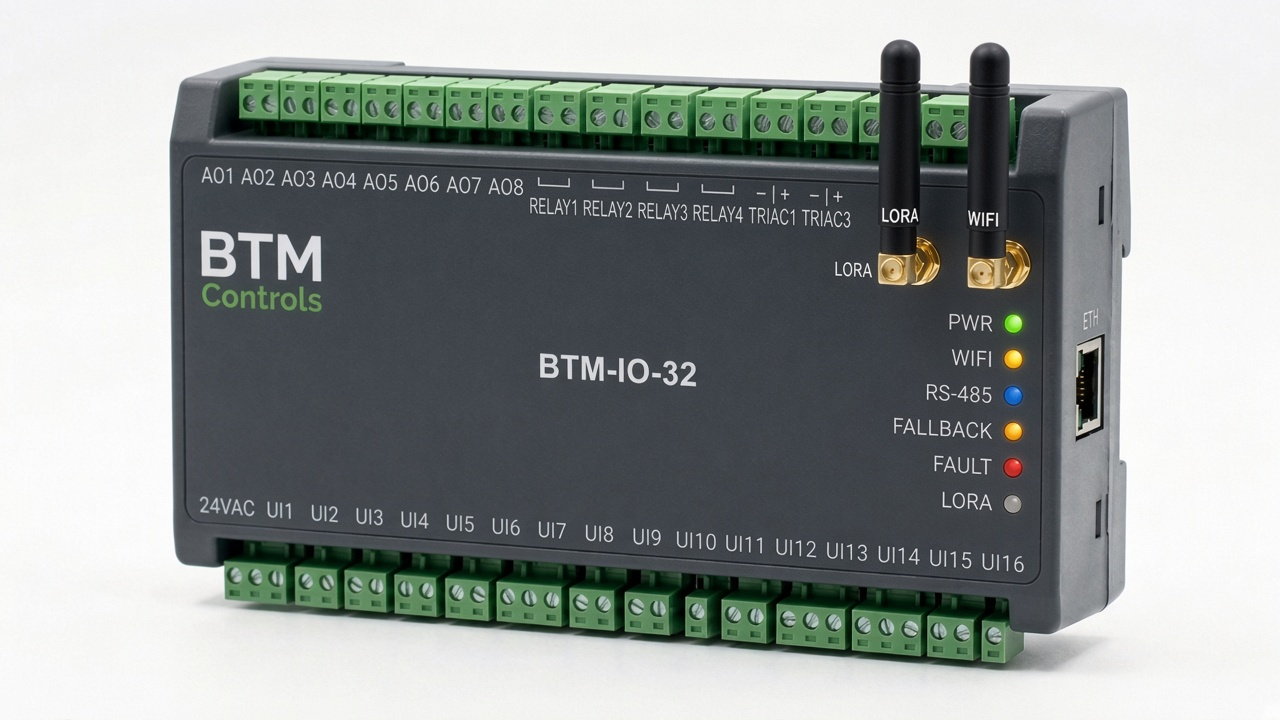
BTM-IO-32 high-density remote I/O with dedicated Wi-Fi and LoRaWAN antennas

BTM-IO-32

High density · big equipment, one module
  • 16Γ— universal inputs
  • 8Γ— analog outputs (0-10V / PWM)
  • 4Γ— relays (Form C, 5A) + 4Γ— triacs
  • Private US915 LoRaWAN + WiFi 6 + Ethernet + isolated RS-485
πŸ“‘

Private Long-Range BAS

Every BTM-IO is a private US915 LoRaWAN Class C field controller with an external antenna path for metal panels. It sends telemetry and receives supervised commands through the K1 gateway, while Ethernet, WiFi 6, and isolated RS-485 provide additional installation paths.

πŸ”‹

Keeps Running When the Network Doesn't

On-board flash stores the last valid commands and a fallback program. Lose connectivity and outputs hold or fail to configured safe states, inputs keep logging, and everything syncs when the K1 reconnects. BTM PowerGuardβ„’ supercap backup adds intelligent load shedding, graceful shutdown, and outage reporting on power loss.

πŸ”§

Same Field-First DNA

24VAC/DC panel power, miswire-proof universal inputs, isolated RS-485, 5A relays, and phone-based commissioning over Bluetooth. Same universal input flexibility as the K1 β€” 0-10V, 4-20mA, 10K thermistor, dry contact, pulse.

Network security architecture

Secure communications without sacrificing safe local operation

BTM-IO modules are designed around MQTT over TLS with hardware secure-element storage for device keys, commissioning that does not require an exposed cloud service, and only the services needed for the selected BAS integration. Modules are intended for segmented BAS/OT networks with least-privilege firewall rules. If communications are interrupted, configured hold-last or safe-state behavior remains local to the module rather than depending on the network.

BTM-IO security controls are part of the product design and remain subject to production firmware, interoperability, and penetration validation.

BTM-IO family is in design. Specifications and pricing published at launch.

Compact universal I/O edge controller

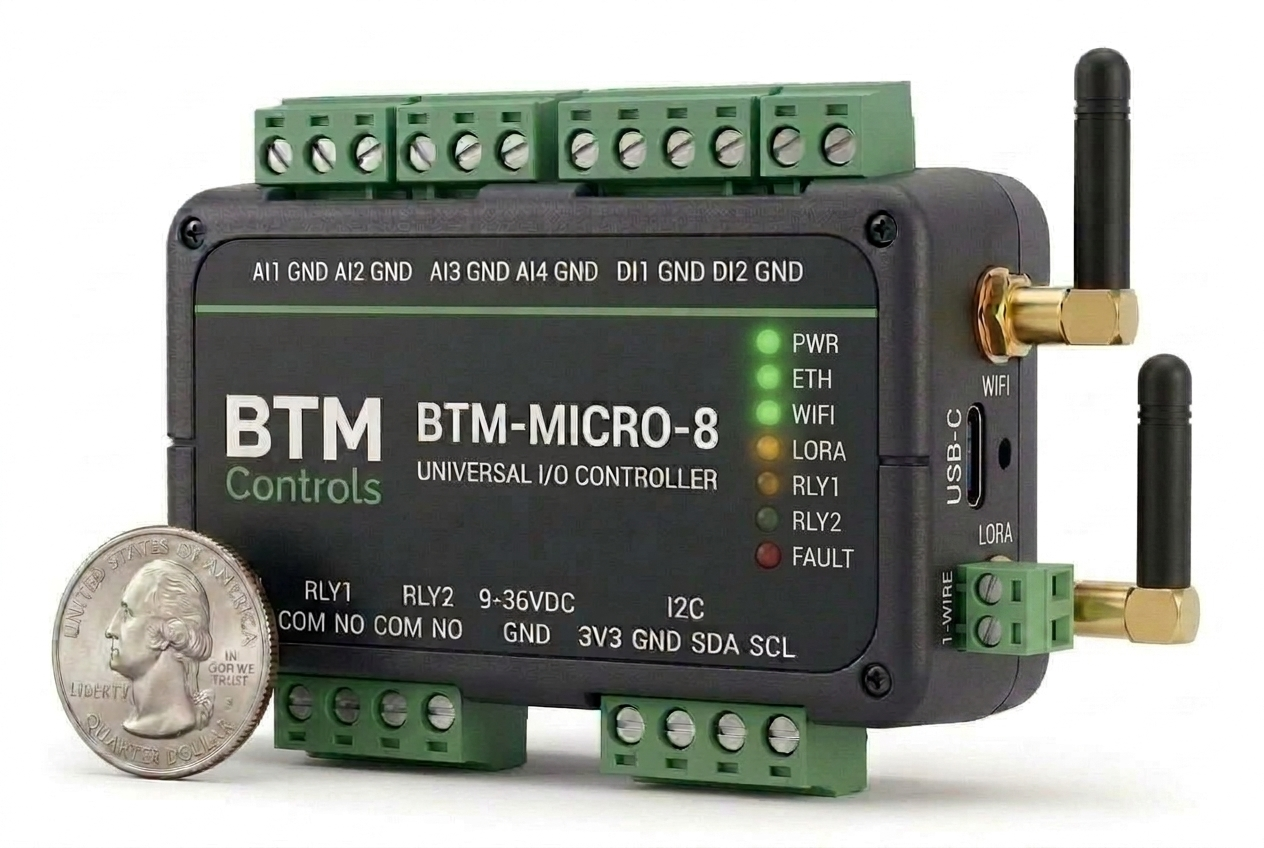
Meet the BTM-MICRO-8

Four precision analog inputs, two protected digital inputs, two dry-contact relay outputs, Ethernet/PoE, 9–36 VDC auxiliary power, Wi-Fi 6, private US915 LoRaWAN, and a fully local dashboard in a compact field controller. The quarter shows the actual scale.

Built for telemetry, metering, retrofit sensing, equipment status, remote point collection, and two supervised dry-contact outputs. Deterministic firmware owns physical output behavior; network commands pass through the controller’s authorization and safety path.

4 analog0–10 V, 0–30 V, or 4–20 mA assembly options
2 digitalContact, status, occupancy, and pulse counting
2 relaysPotential-free COM/NO dry-contact outputs
Ethernet / PoE10/100 wired network and isolated power
BTM-MICRO-8 universal I/O controller with dedicated Wi-Fi and LoRaWAN antennas beside a United States quarter for scale

Protected Precision Inputs

Four precision analog channels plus two digital/contact/pulse channels and two supervised dry-contact relay outputs. The production Rev-A front end adds field protection, scaling, burden resistors, comparators, and a 16-bit ADS1119 ADC.

📡

Long-Range K1 Connectivity

Private US915 LoRaWAN carries metering, alarms, point updates, and acknowledged supervisory commands directly between the MICRO-8 and the K1 gateway. The field device has no direct route into the customer’s corporate IP network.

📡

Local-First Commissioning

WPA2-protected setup access point, authenticated HTTPS dashboard, persistent point names and modes, minimal health endpoint, mDNS discovery, secured configuration API, and signed local firmware updates. No cloud account is required.

🌐

Network Telemetry

Authenticated HTTPS dashboard and REST/JSON, MQTT 3.1.1 telemetry, Modbus TCP register reads, and BACnet/IP Who-Is/I-Am discovery response over the local network.

🌡

Sensor Expansion

1-Wire for temperature and identification sensors, plus short-distance I²C for the precision ADC and local expansion devices.

🛡

Panel-Ready Radio

ESP32-C6-WROOM-1U-N8 with a certified-module RF path and approved external antenna—better suited to metal control panels than a hidden PCB antenna.

Protocols and interfaces

The current prototype firmware has working network services; serial and sensor buses require the production Rev-A hardware.

HTTPS DASHBOARDAUTHENTICATED REST / JSONmDNSMQTT 3.1.1MODBUS TCP FC03BACNET/IP DISCOVERYSIGNED DUAL-OTAWPA2 SETUP APTHREADZIGBEEMATTERBLUETOOTH LEMODBUS RTU*BACNET MS/TP*1-WIRE*I²C*

* Production-hardware interface. BACnet/IP currently provides Who-Is/I-Am discovery response; full B-ASC conformance is not claimed. Thread, Zigbee, Matter, and Bluetooth Low Energy are MICRO-8 wireless capabilities.

Verified prototype network security

Default-deny management and cryptographically controlled updates

MICRO-8 prototype security has been exercised on the physical ESP32-C6: unique per-device WPA2 setup credentials, an authenticated HTTPS dashboard and API on port 443, and cleartext HTTP limited to a minimal health response with management redirected to HTTPS. Modbus TCP and BACnet/IP listeners are disabled until explicitly enabled. Firmware updates require local physical presence, a five-minute maintenance window, and a valid ECDSA P-256/SHA-256 signature before the inactive OTA image can be selected for boot. The controller operates locally without a cloud account.

Production deployment should use a dedicated BAS/IoT VLAN, least-privilege firewall rules, unique device certificates, and protected offline release-signing keys. Formal penetration and production-hardware validation remain pre-release requirements.

Inside the controller

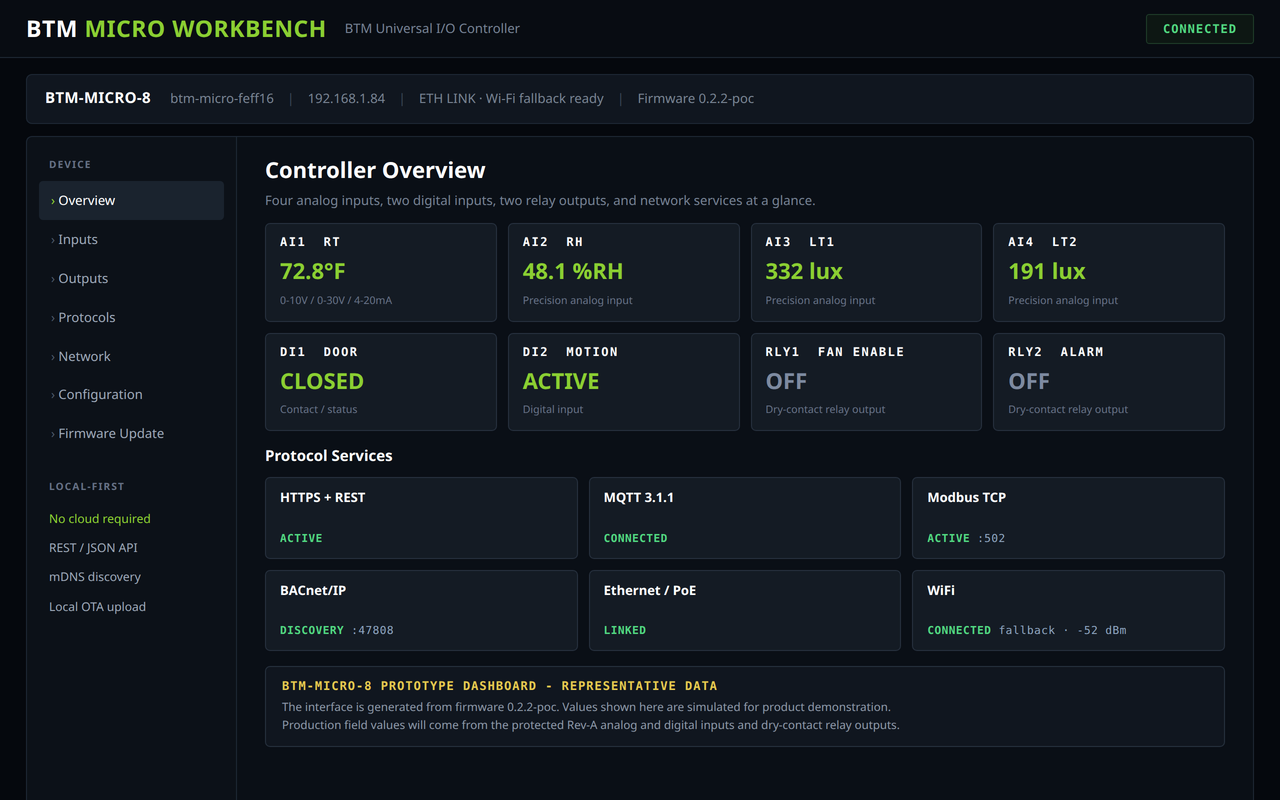
A complete dashboard in the device

Open the MICRO-8 from a phone or laptop to see all eight points, network health, firmware identity, and protocol status. Rename points, configure Wi-Fi and MQTT, inspect diagnostics, and upload firmware locally.

Dashboard shown from firmware 0.2.2-poc with clearly identified representative prototype values.

BTM-MICRO-8 embedded local dashboard showing analog, digital, relay, network, and protocol status

BTM-MICRO-8 combines protected mixed I/O, wired and wireless networking, local commissioning, and deterministic field control in one compact controller.

BTM-K1 Full Specifications

Every feature below is part of the BTM-K1 platform design. Final production specifications published at launch.

Processor: Quad-core 64-bit ARM Cortex-A53 @ 1.4GHz + Cortex-M4F real-time core
Memory: 1GB DDR4 (in-package), microSD storage, eMMC option
AI Engine: Dedicated RISC-V NPU co-processor with integrated memory, camera vision inference at the edge
Camera: MIPI-CSI camera input for vision AI (person detection / display wake, points-list & programming-document scanning for setup)
Audio: On-board MEMS microphone β€” push-to-talk technician voice assistant
Display: Integrated color touchscreen HMI (local dashboard, alarms, setpoints)
Ethernet: 2Γ— 10/100/1000 Gigabit ports β€” dual-network or daisy-chain topologies, TSN-capable silicon
Wireless: WiFi 6, Bluetooth 5.3, 802.15.4 (Zigbee / Thread / Matter), plus private US915 LoRaWAN gateway with external antenna ports
LoRaWAN: SX1302-class multichannel gateway, local ChirpStack network services, Class C BTM field-device supervision, RF health and BACnet/MQTT translation
Field Bus: Isolated RS-485 (BACnet MS/TP, Modbus RTU) + dedicated second RS-485 expansion bus
CAN: CAN-FD port (CANopen, J1939)
Universal Inputs: 4Γ— UI β€” 0-10V, 4-20mA, 10K thermistor, dry contact, pulse/meter count β€” 24VAC miswire-proof
Analog Outputs: 2Γ— 0-10V / PWM, short-circuit protected
Digital Outputs: 4Γ— relay (Form C dry) + 4Γ— triac (24VAC, zero-cross) β€” 14 total on-board points
1-Wire: Sensor bus for DS18B20 temperature chains
Expansion: Qwiic/STEMMA QT I2C connector + GPIO expansion header + BTM-IO remote module network
USB: USB-C (device/config) + USB-A host
Power: 24VAC/DC panel transformer input with surge/reverse protection, USB-C bench power, power-fail safe shutdown with supercap RTC
BTM PowerGuardβ„’: Integrated maintenance-free supercapacitor backup β€” intelligent load shedding, hardware soft-shutdown built into the circuit, outage reporting via BACnet/MQTT last-gasp
Security: ATECC608 hardware secure element, secure boot capable, hardware crypto
Software: Debian Linux, BACnet/IP + MS/TP stacks, Modbus, MQTT, Node-RED ready, HTML5 web UI, REST API, phone commissioning hotspot
Protocols: BACnet/IP Γ—2 ports, BACnet MS/TP, Modbus RTU/TCP, CAN-FD, MQTT, Zigbee/Thread/Matter, BLE, WiFi 6, 1-Wire, NATS
Licensing: NONE. No per-point fees, no per-driver fees, no annual maintenance contracts required
The Controller That Pays for Itself

Every competitor controller reacts. A PID loop sees the space is hot, then starts cooling β€” after the peak-price meter is already spinning. The BTM-K1 thinks ahead.

Predictive Control vs. Reactive Control

The K1's quad-core engine runs Model Predictive Control (MPC): it learns your building's actual thermal inertia from its own trend data, then simulates hundreds of control strategies against tomorrow's real-time electricity price curve β€” ERCOT hourly pricing first, the most volatile grid market in America.

The result: the K1 pre-cools your building's thermal mass when power is cheap and coasts through the afternoon price peak with the compressor off β€” while a reactive controller is buying its energy at the day's worst prices. Published field studies of this class of neural-network MPC on edge controllers report 23–37% energy cost reductions, ~70% less overshoot, and dramatically faster settling than traditional PID loops.

At $1,499, one Texas summer of peak-shaving can return the entire cost of the controller. The competition can't answer this β€” their architecture reacts; the K1's plans. And the split is engineered for reliability: the application cores compute the optimal trajectory, while a dedicated real-time core executes the electrical control deterministically.

Savings figures cite published third-party field results for ANN-based MPC on edge controllers. Your results depend on building mass, equipment, and utility rate structure.

A day in the life β€” predictive vs. reactive
4:00 AMGrid price low β†’ K1 pre-cools building thermal mass
7:00 AMReactive controllers wake up and start buying energy
1:00 PMPrice peak begins β†’ K1 coasts on stored cooling
4:00 PMPeak pricing Γ—10 β†’ competitor compressors at full draw
6:00 PMPeak ends β†’ K1 resumes normal staging, comfort never lost
β†’ Published field results: 23–37% energy cost reduction vs. reactive PID control

Grid-Interactive Efficient Building (GEB) Technology

BTM Controls has developed foundational Grid-Interactive Efficient Building technology. The BTM-K1 autonomously optimizes large package units while simultaneously communicating with broader Energy Management Systems (EMS) and SCADA networks β€” over BACnet/IP, Modbus, and MQTT, out of the box.

That combination β€” edge autonomy plus grid connectivity β€” is exactly what the U.S. Department of Energy's multi-year GEB vision calls for: buildings that act as flexible, resilient assets on a decarbonized grid, shifting and shedding load in response to grid signals instead of consuming blindly. Most controllers can be told what to do by an EMS. The K1 can think for its equipment and answer the grid at the same time.

Head to Head

BTM-K1 vs. Tridium JACE 9000 vs. Distech ECLYPSE APEX β€” the two flagship supervisory controllers in commercial BAS today.*

BTM-K1JACE 9000ECLYPSE APEX
ProcessorQuad-core 64-bit @ 1.4GHz + real-time coreQuad-core ARMQuad-core ARM
Vision AI / NPU on-boardβœ” NPU + camera input✘ NoneEdge analytics (no vision)
Touchscreen HMI on unitβœ” Integrated✘ None✘ None
On-board field I/Oβœ” 4 UI / 2 AO / 4 relay / 4 triac β€” runs an RTU standalone✘ Requires IO-R modules✘ Requires ECx-IO modules
Dual Gigabit Ethernetβœ” + daisy chainβœ”βœ”
WiFiβœ” WiFi 6 + hotspot commissioningOptional moduleAdapter / model dependent
Zigbee / Thread / Matterβœ” Native 802.15.4✘✘
BACnet/IP + MS/TPβœ” Isolated MS/TP portβœ” (licensed drivers)βœ”
Modbus RTU/TCPβœ”βœ” (licensed drivers)βœ”
CAN bus (CANopen/J1939)βœ” CAN-FD✘✘
MQTT / IoTβœ” MQTT + REST + NATSβœ” via Niagaraβœ” REST API
Expansion I/O busβœ” BTM-IO (coming)βœ” IO-R (to 4,000 ft)βœ” ECx series
Hardware secure elementβœ” ATECC608TPM-basedModel dependent
No lock-inβœ” Debian Linux✘ Niagara licensed✘ Proprietary + licensed
Per-point / driver licensingNONEPoint/driver packs + SMALicense tiers
Predictive energy optimization (MPC)βœ” Learns thermal mass, optimizes vs. grid pricing✘ Reactive PID / scheduled logic✘ Reactive PID / scheduled logic
AI vibration analysis / machine healthβœ” Built-in β€” baselines equipment, flags bearing wear & short-cycling✘ Requires third-party system✘ Requires third-party system
Two-way AI communication with technicianβœ” Push-to-talk voice + on-screen answers, fully offline✘ None✘ None
AI alarm root-cause diagnosticsβœ” One-button "Explain This Alarm" from on-board trends✘ Raw alarm list✘ Raw alarm list
Scan commissioning documents / point changesβœ” Camera + AI reads points lists & submittal schedules for setup✘ Manual entry✘ Manual entry
Supercap backup + outage reportingβœ” BTM PowerGuardβ„’ standard β€” load shedding, last-gasp report✘ None standard✘ None standard
Phone commissioningβœ” Built-in hotspotβœ˜βœ” BLE app
Typical cost*$1,499$4,000–$7,500+$2,500–$5,000+

The Price Revolution

Enterprise-class supervisory control shouldn't cost more than the equipment it manages. Estimated street pricing, typical configurations:*

LAUNCHING SOON

BTM-K1

$1,499
target launch price β€” no license fees, ever
  • βœ” Vision AI + camera included
  • βœ” Touchscreen HMI included
  • βœ” On-board I/O included
  • βœ” All protocols included
  • βœ” WiFi 6 / Thread / Matter included
  • βœ” Lifetime platform updates

Tridium JACE 9000

$4,000–$7,500+
typical w/ Niagara licensing & SMA
  • ✘ I/O modules sold separately
  • ✘ Driver & point-count licensing
  • ✘ Annual maintenance agreements
  • ✘ Certified-partner channel required
  • ✘ No AI, no display, no camera

Distech ECLYPSE APEX

$2,500–$5,000+
typical w/ licensing, config dependent
  • ✘ I/O extensions sold separately
  • ✘ License tiers by capacity
  • ✘ Closed ecosystem
  • ✘ No touchscreen, no camera vision
  • βœ” Solid edge analytics

Why BTM Controls?

We're controls people who got tired of paying enterprise prices for decade-old hardware wrapped in license agreements.

Field-First Design

Designed by people who wire panels β€” 24VAC transformer power, miswire-proof inputs, isolated field bus, terminals labeled the way techs actually think.

Modern Silicon

Current-generation industrial processors with 10+ year lifecycles β€” not 2011-era chips at 2026 prices. AI acceleration built in, not bolted on.

Interoperable

Linux. Standard protocols. Real REST APIs. Your data, your logic, your building β€” no ransom licensing, no certified-dealer gatekeeping.

Be First in Line

The BTM-K1 is in final development. Get launch pricing, beta program invites, and integration previews.

[email protected]
β˜… Beat'em with BTM β˜